

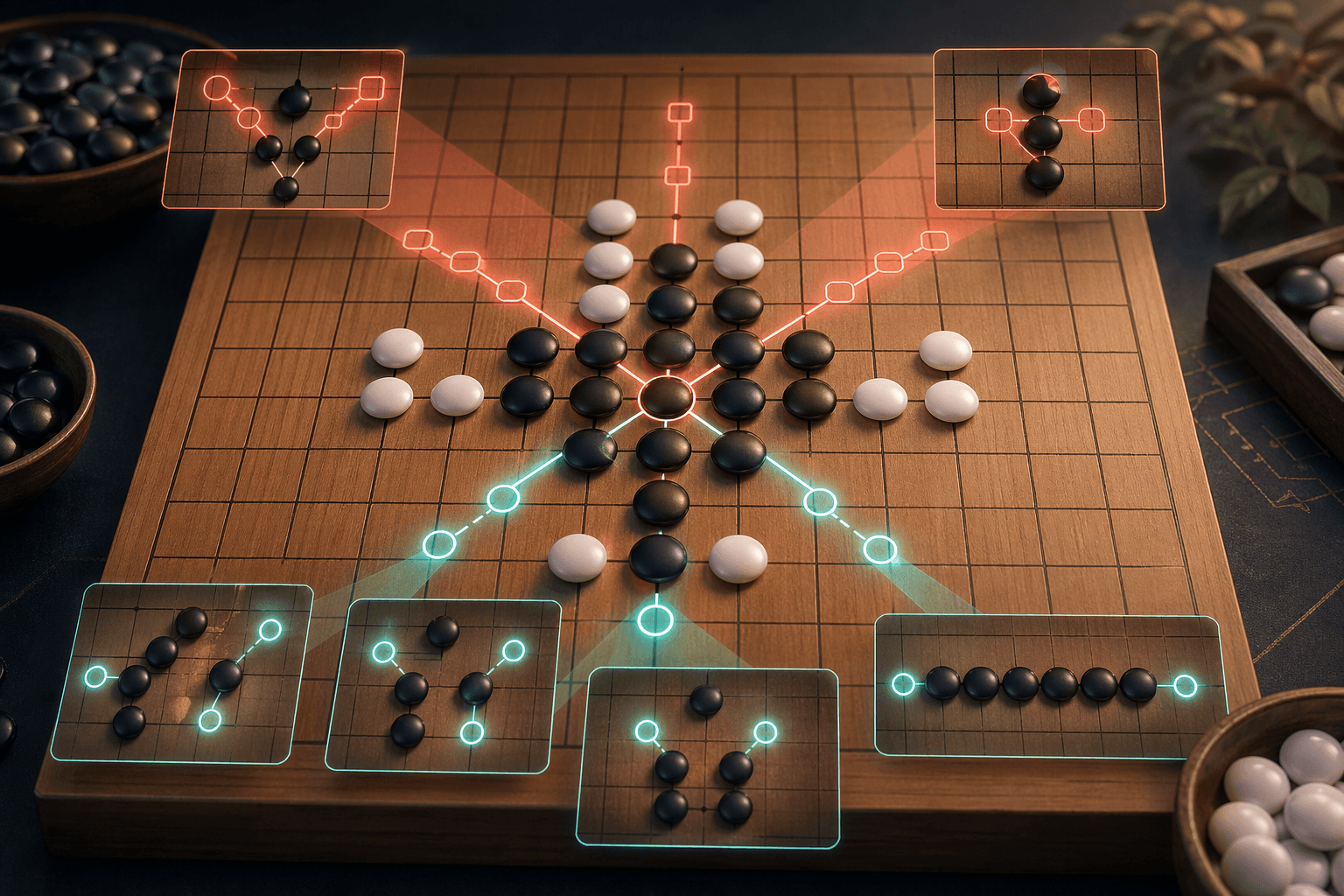
Quick Answer: What Exactly Are Forbidden Moves in Competitive Gomoku?
If you want to get straight to the point, just remember this: Under the competitive forbidden moves rule, Black has forbidden moves while White has no restrictions; if Black places a long consecutive line (long chain), a double four, or a double three, that move is not allowed.
This is a common source of confusion for many players when switching from 'casual rules' to 'competitive rules.' Casual play usually involves no forbidden moves, with the first to connect five stones winning; Competitive forbidden moves add special restrictions to some of Black’s stronger moves, making the game more balanced between offense and defense.
If you want to follow the rules and test out positions at the same time, you can easily open O.Convertor Online Gomoku. This page already separates 'casual rules' from 'competitive forbidden moves,' making it easier to connect the rules with how pieces are actually placed.
Why are forbidden moves included in competitive rules?
In Gomoku, black plays first and inherently has a slight tempo advantage. Without any restrictions, the first player often finds it easier to maintain control throughout the game. The main purpose of forbidden moves (竞技禁手) in competition is to place extra restrictions on black’s moves, preventing the game from quickly becoming one-sided in black’s favor.
So you can understand these rules as: they are not meant to complicate Gomoku, but to balance the advantage between the first and second players.
For casual players, the most helpful way to grasp this is not by memorizing technical terms, but by first understanding two key points:
- Casual rules: No forbidden moves; whoever first connects five stones wins.
- Competitive forbidden moves: Forbidden moves apply only to Black; White is unrestricted.
Once you understand this distinction, the concepts of long chains, double fours, and double threes won’t seem confusing.
How do the restrictions for Black differ from those for White?
You can think of the current set of rules simply as follows:
- Black has forbidden moves
- White has no restrictions
This means that at the same spot, a move by black might be forbidden, while a move by white could be completely legal. This is often the most confusing part for beginners when first learning competitive rules, because it’s not that 'this point is never allowed,' but rather 'this point cannot be played by black on this particular turn.'
So in actual play, don’t just focus on the board patterns themselves; first check two things:
- Whose turn it is
- Whether the competitive forbidden move rules are being used
How should we understand the three kinds of forbidden moves?
In competitive play, the three most commonly referenced forbidden moves for black are: long chain, double four, and double three.
Forbidden Long Chain
A long chain can be roughly understood as follows: after Black places a stone, the stones connected in a line are not just five, but six or more in a row.
Under casual rules, many players instinctively think 'the longer the chain, the stronger,' but in competitive forbidden moves rules, this is not the case for Black. For Black, only exactly five in a row counts as a valid winning move; if a move creates a long chain, it is considered a forbidden move.
A common mistake in actual play is when you see 'this line will surely connect,' but fail to notice that both ends have already extended, making the move create not five in a row, but six or more.
Double Four Forbidden Move
The 'Double Four' can be initially understood as: After Black places this move, it simultaneously creates two very strong 'four' attack points.
Why is it dangerous? Because a 'four' is already very close to an immediate winning threat, creating two such strong threats in one move often puts the defender in a difficult position. Competitive rules classify this as a forbidden move precisely because this attack is too powerful.
You don’t need to memorize all the specific shape names right away, but you should develop this way of thinking: if Black’s move instantly creates two strong threat points in different directions, you should be alert that it might be a double four.
Double Three Forbidden Move
The double three is often the most confusing forbidden move for many people. A simple way to remember it is: when Black plays this move, it simultaneously creates two separate 'three' formations, both of which have strong attacking potential going forward.
It is difficult to judge because a 'three' formation is not as straightforward as a 'four.'Many times, you might just see that 'there’s an opportunity in this direction and also another in that direction,' but the competitive rules focus on whether a single move instantly produces two active threats at once.
For beginners, the safest approach is not to rely only on guesswork but to observe the outcomes of actual moves several times. You will gradually realize that the challenge of the double three (双三) is not in its name, but in whether ‘after this move, Black immediately creates two separate lines that can both continue to develop an attack.’
What are some common mistakes?
When first learning about competitive forbidden moves, the most common mistakes typically fall into these categories:
-
Applying casual rule habits directly to competitive rules Previously, you might have thought ‘if you can extend or push forward, do it.’ After switching to competitive rules, this kind of instinct can easily result in a forbidden move.
-
Focusing on only one direction without considering the overall impact of the move Double three (双三) and double four (双四) are often not issues in just one direction, but moves that simultaneously affect two directions.
-
Thinking White Has the Same Restrictions
-
Mistaking a ‘Long Chain’ for a ‘Stronger Five in a Row’
-
Failing to Confirm the Rule Set When Spotting Opportunities
How Can You Practice Judging Forbidden Moves in Online Gomoku?
If you only read the definitions, it often remains unclear in your mind; When the game really gets underway, decisions usually come down to 'looking one move ahead, the next step, and immediately knowing the outcome.'
An easier way to practice is to use a browser-based site like O.Convertor Online Gomoku, where you can start a game directly and practice as follows:
- First, switch to the competitive forbidden moves rule, then begin placing stones.
- Pay special attention to black’s turns, observing which moves you originally thought were strong actually cannot be played.
- Try several edge-case scenarios, especially those that affect two directions at the same time.
- Then switch back to the casual rules for comparison—you’ll find it easier to see the differences between the two rule sets.
If you prefer to begin with a lighter gameplay experience through a browser, you might also find this related article helpful: How to Easily Play Free Online Gomoku? Why Starting in Browser Is More Convenient.
Common Questions
1. Are forbidden moves applied to both players in competitive Gomoku?
No. According to the current rules, only black has forbidden moves, while white faces no such restrictions.
2. What is the key difference between competitive forbidden moves and casual rules?
The main difference is that casual rules have no forbidden moves—whoever first connects five stones in a row wins—whereas competitive rules impose additional restrictions on black’s moves, specifically prohibiting long chains (长连), double fours (双四), and double threes (双三).
3. Why was I told I couldn’t place a stone even though I was clearly about to win?
This usually happens because you see ‘this move is very strong,’ but the rules check whether ‘this move creates a forbidden move.’ In competitive play, a strong move isn’t always legal—especially when it’s Black’s turn.
4. Does a long chain count as a win?
In competitive forbidden move rules, a long chain is considered a forbidden move for Black, so it doesn’t count as a normal win.
5. What’s the best way to learn about forbidden moves?
First, understand the differences in restrictions for Black and White. Then, repeatedly review real game positions and outcomes. Simply memorizing definitions isn’t reliable; learning through actual gameplay is much more effective.
If you’re planning to move from casual Gomoku to the competitive rules, the easiest way is to play while paying close attention. You can try O.Convertor Online Gomoku. After switching the rules to ‘competitive forbidden moves,’ play a few moves and you’ll quickly learn to tell which are normal strong moves and which carry risks like long chains, double fours, or double threes.